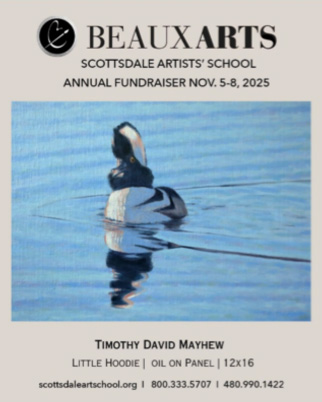
Beaux Arts fundraiser for the Scottsdale Artists' School….October 17, 2025 Greetings, I am pleased to announce that I will be participating in the 2025 Beaux Arts, An evening for Art, fundraiser for the Scottsdale Artists’ School in Scottsdale, Arizona, which will be held from November 5-8th. There will be an In-Person Gala on Saturday, November 8, from 6-9 pm. The Scottsdale Artists’ School is one of America’s foremost independent art institutions, offering a large array of art programs for adults, a premier youth academy and extensive outreach programs. The success of the Scottsdale Artists’ School is centered on the quality of its instructors, who are all professional working artists. Proceeds from the Beaux Arts fundraiser are important in supporting the School’s educational initiatives. This year I will have a small oil painting of a swimming hooded merganser.
This is one of several preparatory oil paintings and drawings that I did during 2025 for a large painting that included a male hooded merganser, or as I like to refer to them, hoodies. This particular specimen is a swimming male Hoodie that I studied in the Formosa Slough in Southern California, a favorite winter location for my field studies. The hooded merganser is a small North American diving duck known for the male's distinctive black-and-white crest and the female's brown head. They are unique among North American mergansers for their restricted range and their ability to use tree cavities for nesting. Male hoodies have a prominent white crest surrounded by black, a black back, and white breast and belly. They are strong swimmers and divers, capable of staying underwater for up to two minutes while pursuing prey, often surfacing yards away from their dive. For more information see the School’s website at: https://www.scottsdaleartschool.org/exhibitions/14-beaux-arts-2025-an-evening-for-art/ If you have any questions or comments, I’d love to hear from you. Best, Timothy
Upcoming lecture and workshop at Harvard Art Museums…September 22, 2025 Greetings, once again, I have been invited to host a three-part intensive study on October 8th, 2025, of traditional drawing materials and techniques to accompany Harvard Art Museums’ exhibition, Sketch, Shade, Smudge: Drawing from Gray to Black, created to enable visitors to discover how simple tools can be powerful vehicles for artistic expression. I will present a lecture entitled, Dessin au fusain: The evolution of charcoal from important sidekick to valued soloist, which details the 19th century technical advances and tools that enabled charcoal to evolve from a fragile drawing material, largely used for underdrawings, to become a permanent drawing medium in itself. Key parts of the lecture will cover the many tools used to manipulate the charcoal, how they were used, and the effects they created. I will also conduct a close-looking session within the exhibition to point out and describe the use of these traditional drawing materials and techniques by the 19th to 21st century artists in the exhibition, followed by a hands-on session during which participants will be able to use many of these drawing materials and techniques. Sketch, Shade, Smudge: Drawing from Gray to Black showcases around 120 captivating works, spanning from the 19th to 21st centuries, including drawings by Jean-Auguste-Dominique Ingres, Edgar Degas, Georges Seurat, John Singer Sargent, and Odilon Redon, alongside 20th- and 21st-century artists such as Piet Mondrian, Lyonel Feininger, Diego Rivera, Richard Serra, John Wilson, Isabella Quintanilla, and Toyin Ojih Odutola, all of whom push their use of drawing media in new directions. Included in the exhibition will be a didactic case containing natural grape vine charcoal from John Singer Sargent’s collection as well as traditional drawing materials and tools from my collection, that I have donated to Harvard over my past 30 years of lecturing there. This brilliant exhibition was curated by Miriam Stewart, Curator of the Collection, Division of European and American Art, and Penley Knipe, Philip and Lynn Straus Senior Conservator of Works on Paper and Head of the Paper Lab, Straus Center for Conservation and Technical Studies. Sketch, Shade, Smudge: Drawing from Gray to Black, will be on exhibit fromSeptember 12, 2025–January 18, 2026, in the Special Exhibitions Gallery, Harvard Art Museums. For more information, see Harvard’s website at: https://harvardartmuseums.org/exhibitions/6465/sketch-shade-smudge-drawing-from-gray-to-black If you have any questions or comments, I’d love to hear from you. Best, Timothy
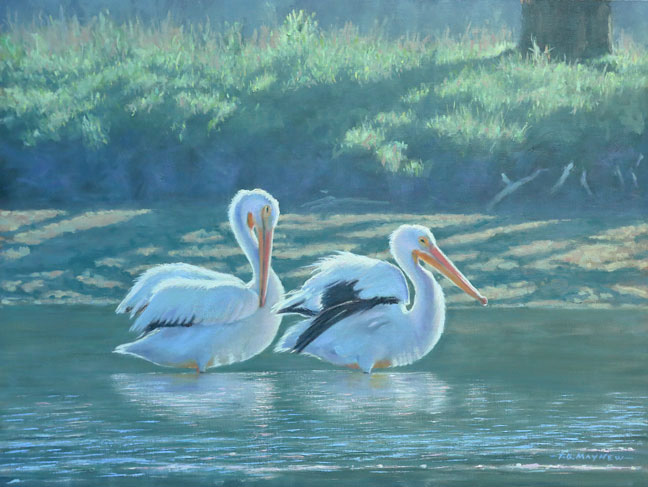
The National Museum of Wildlife Art's 38th annual Western Vision exhibition …August 17, 2025 Greetings, once again, The National Museum of Wildlife Art’s largest and longest-running fundraiser, Western Visions, is one of the signature events of the Jackson Hole Fall Arts Festival. The top contemporary wildlife artists and collectors from around the world will come together at the Museum in breathtaking Jackson Hole, Wyoming, and I am honored to be among them. This is the 38th annual Western Visions and it features a wide selection of art for sale and the money raised from this fundraiser supports the important work of the Museum. The week’s opening events, at the Museum’s award-winning facility across from the National Elk Refuge, draw an international crowd to this critically acclaimed gathering. More than 170 participating artists will be in the exhibition with many, including myself, in attendance. I will have an oil painting entitled, Pelican Valley, (Oil on Belgian linen archivally mounted on birch panel, 15 x 20 inches), which resulted from my field studies in Yellowstone National Park in the fall of 2024. On my trek, I had the good fortune of encountering two white pelicans patiently preening in shallow waters within the Pelican Valley, located northeast of Yellowstone Lake. The scene was bathed in dappled sunlight and they patiently spent over an hour with their grooming. This gave me amble time to do some valuable field studies for use in the studio to create this painting. Pelicans have been living in this part of Yellowstone National Park for centuries. Pelican Creek flows out of the north end of Yellowstone Lake into Pelican Valley, which was named in 1864 by a group of prospectors led by Adam Miller. One of the prospectors, John Davis, mistakenly shot a pelican thinking it to be a goose. The bird came down in the water requiring Davis to swim out and bring it to shore. Even after defeathering and skinning, however, the pelican proved to be inedible and was hung in a tree to be found later by Miller, thus leading to the current name for the valley.
The exhibition opens at the Museum on Saturday, September 6th, and the signature event and sale will be on Thursday, September 11th. Sunday, September 28th will be the last day of the exhibition. For more information see the Museum’s website at: https://wildlifeartevents.org/#about If you have any questions or comments, I’d love to hear from you. Best, Timothy
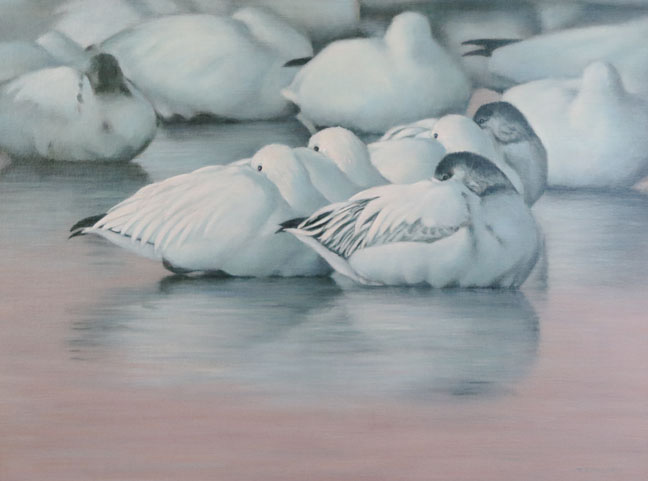
Woodson Art Museum’s 50th Annual Exhibition of Birds in Art…August 7, 2025 Greetings, once again, I am pleased to announce that my next exhibition will be the Woodson Art Museum’s Fiftieth Annual Exhibition of the Internationally-acclaimed, Birds in Art. The exhibition will open to the public onSeptember 6, 2025 and runs through January 4, 2026 and I plan to be there for the opening events as this will be spectacular. Birds, in all their majesty and fragility, connect us with the natural world. Included will be the most talented artists invited from around the world, which serves as a fitting tribute to this year’s milestone 50th annual exhibition. Discover how artists’ interpretations of birds inspire you and why, throughout five decades, Birds in Art has garnered international acclaim. Experience 112 new works of art, in addition to thirty works from the Woodson Art Museum’s permanent collection—representing world class artists and each of the past Master Wildlife Artists in the Leigh Yawkey Woodson Art Museum’s 50th internationally-renowned Birds in Art exhibition. I am honored that, as one of the Museum’s designated Master Wildlife Artists (inducted in 2020), I will be represented by one of my oil paintings in the Woodson’s permanent collection for this 50th anniversary exhibition. The painting is entitled, Goose Down (oil on Belgian linen, Oil on Belgian linen, 18 x 24 inches).
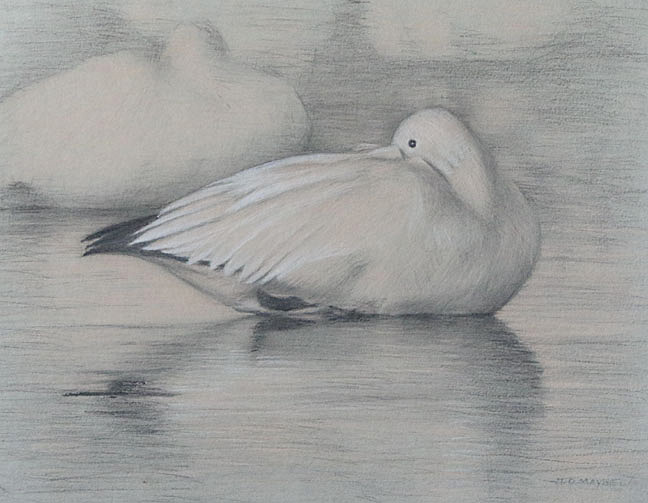
Every year thousands of snow geese migrate from their summer breeding grounds in the northern Alaska and Canada to winter along the Rio Grande Valley in my home state of New Mexico. During one of my field trips to study them in January 2018 the nighttime temperatures had dropped to well below freezing. I arrived before sunrise to study the geese in the pre-dawn glow and encountered thousands of snow geese sleeping on the ice that had formed during the night. Their bills were buried in the warm downy feathers along their backs and their legs and feet were raised up off the ice and tucked under the down on each side of their bellies. I was extremely impressed with the insulating ability of their goose down and soon found myself wishing that I had some to keep me warm in the bone-chilling cold. As the pre-dawn glow illuminated the Magdalena Mountains to the west they reflected a warm reddish hue onto the ice. The geese continued to sleep but would occasionally open their eyes in anticipation of sunrise. Then, just after sunrise as if by some secret signal, all of the snow geese vaulted into the air creating thunderous sounds with their wings and the cacophony of their vocalizations. I had witnessed this event before and it was always inspiring, but this time I was closer to the geese and their chosen route was directly toward me. I was quickly surrounded by thousands of snow geese flying around and above me and encapsulating me in a mesmerizing display of sound and flight that went on for what felt like an eternity. My field studies typically consist of drawings, some of which become invaluable references in the studio to enable me to create larger compositions for my oil paintings. Such as this one, Right side study of a sleeping snow goose with head turned back (Natural black chalk, natural red chalk, and natural white chalk on handmade gray wove paper, 11 x 14 inches), which was one of the preparatory drawings for my Goose Down painting and was also acquired by the Woodson in 2018.
For more information see the Museum’s website at: https://www.lywam.org/exhibitions-archive/birds-in-art-fifty If you have any questions or comments, I’d love to hear from you. Best, Timothy
|
No material on this website may be duplicated, borrowed, printed or displayed elsewhere without permission. |